On the night of Sunday, October 11, attackers compromised the refrigeration infrastructure across hundreds of French supermarkets, hitting chains including Intermarché, Coopérative U, E.Leclerc, Carrefour Market, and Monoprix.
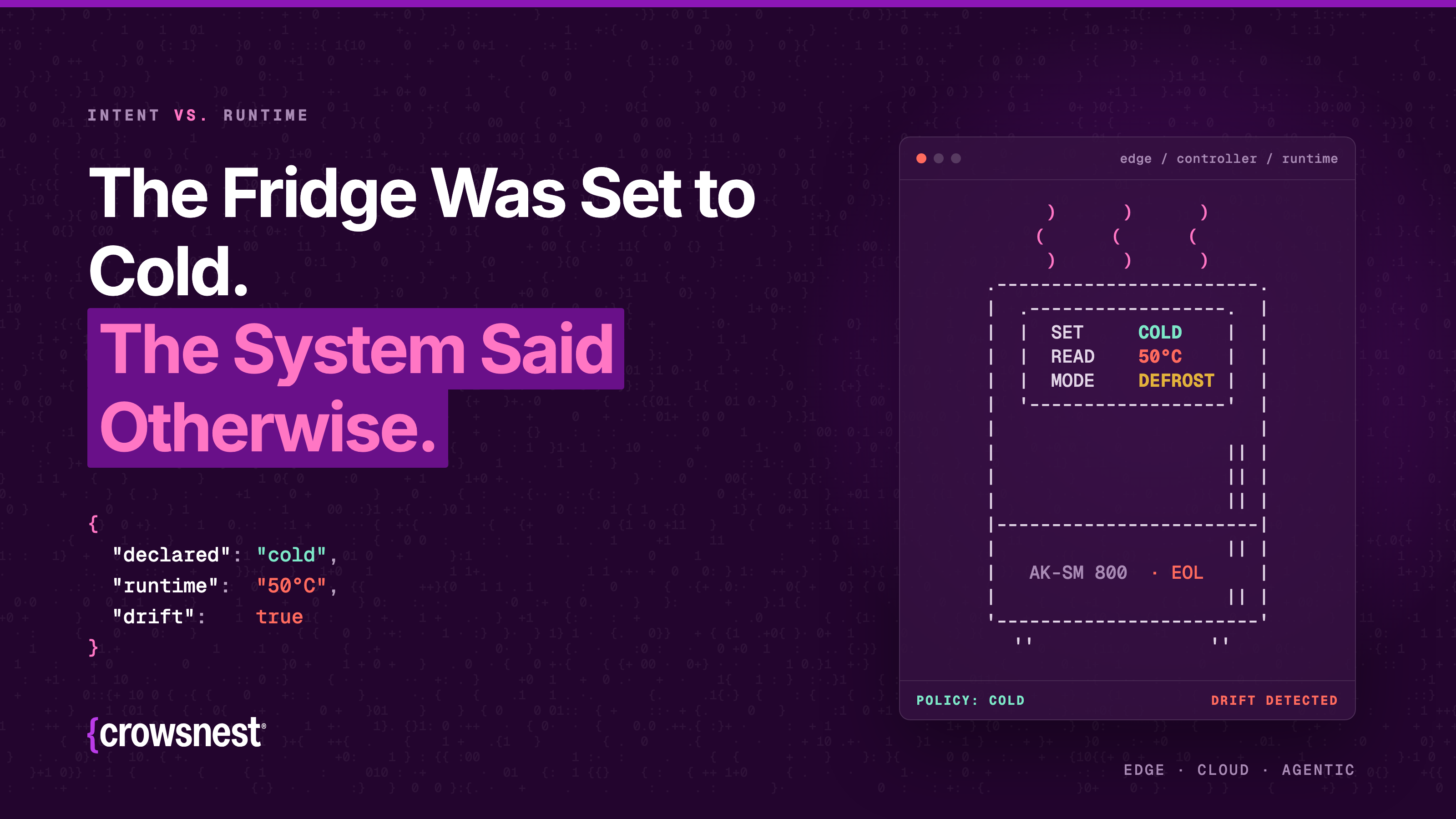
Rather than deploying conventional extortion ransomware against back office databases, the attackers altered the operating logic of Danfoss refrigeration controllers, driving units into permanent defrost cycles. Temperatures inside industrial cooling systems rose to 50°C (122°F). Fresh and frozen stock across entire regional hubs had to be destroyed, and Paris prosecutors confirmed that thermal overloads sparked localized fires.
France’s cybersecurity agency, ANSSI, via CERT-FR, issued an emergency alert identifying compromised Danfoss controllers, specifically legacy AK-SM 800 and AK-SC 355 units (both long past their end-of-life dates), alongside current generation AK-SM 800A controllers operating on outdated firmware.
Danfoss noted that advisories had long urged customers to update. The fixes existed. The deployed systems simply did not have them.
The core issue here is not that grocery chains failed a routine compliance review. It is that modern security posture management relies on a fundamentally obsolete model: the assumption that documented intent matches operational execution.
The Three Layers of System State
Every enterprise operating connected infrastructure has three distinct versions of reality:
- Declared Intent (Policy): The documentation, compliance checklists, SOC 2 control mappings, and vendor questionnaires stating how systems ought to run.
- Recorded Configuration (Control Plane): What the central management dashboard, API console, or configuration database reports.
- Execution Reality (Runtime): What the edge microcontroller, bare metal register, kernel module, or running process is actively doing right now.
Virtually all conventional Governance, Risk, and Compliance (GRC) and Security Posture Management tools live strictly within layers 1 and 2. They poll APIs, parse static IaC scripts, ingest configuration files, and match them against static control frameworks.
In France, the policies mandated precise cold chain standards. The vendor questionnaires likely certified baseline compliance. But the physical execution state diverged catastrophically: the policy said "cold," and the physical setpoint registered 50°C.
A security control does not exist unless the system is actively enforcing it at runtime.
The Third-Party Trap: From "123456" to Industrial Edge
The Danfoss vulnerability demonstrates how deeply third party dependencies sit inside your attack surface. You can run strict internal identity controls, but if a third party maintenance vendor maintains an unverified remote access tunnel to an edge gateway, your perimeter is non-existent.
We saw this exact systemic vulnerability just days prior in Denmark. The Danish national CPR register containing personal records on approximately 8.8 million people was breached after an attacker accessed accounts at Pays ApS, an external IT service provider with authorized system access. The administrative entry point was an account secured with the password 123456.
Whether it is an IT vendor managing citizen databases or a refrigeration contractor managing supermarket cooling loops, the pattern remains identical: access is granted based on an upfront assumption of compliance, with zero continuous verification of runtime behavior.
A vendor questionnaire asks what a supplier intends to do. It cannot tell you what their software or remote tunnel is executing inside your network right now.
The Modern Architectural Sprawl: Hardware, Cloud, and Agentic Code
Securing this surface is no longer a matter of simply telling technicians to patch edge controllers. Enterprise engineering footprints have expanded into a complex, heterogeneous topology:
- Hardware & Edge OT: Legacy microcontrollers, programmable logic controllers (PLCs), and building management engines running constrained firmware and proprietary protocols.
- Centralized Cloud Workloads: Ephemeral microservices, dynamic Kubernetes nodes, and multi-cloud API gateways with continuous configuration changes.
- Agentic and Autonomous Systems: Autonomous AI agents, automated CI/CD runners, and automated orchestration workflows executing code and modifying parameters without human mediation.
These environments are deeply interconnected. A centralized cloud optimization service writes adjustments down to an edge controller; an AI code agent pushes infrastructure updates to production clusters.
When configuration drift or an intrusion occurs anywhere across this continuum, point-in-time scanners and legacy Cloud Security Posture Management (CSPM) tools fail:
- Static scanners cannot inspect the real-time register states of edge OT controllers.
- Traditional perimeter tools cannot distinguish an authorized optimization change from an attacker overriding a setpoint via an authorized vendor pipe.
- Centralized dashboards cannot react at the speed of autonomous, agentic configuration drift.
The Privacy and Data Sovereignty Imperative
When confronted with edge-to-cloud security blind spots, traditional cybersecurity vendors typically propose a brute force solution: mirror all raw operational logs, telemetry, and payload traffic into a centralized, third party cloud data lake for analysis.
For critical infrastructure, industrial operations, and privacy sensitive enterprises, that approach creates severe structural problems:
- Supply Chain Exposure: Aggregating raw operational and process data into external SaaS repositories creates a high-value single point of failure.
- Regulatory & Sovereign Friction: Transporting operational telemetry across jurisdictions violates critical infrastructure rules, NIS2 requirements, and data sovereignty principles.
- Bandwidth and Latency Constraints: Edge and OT environments cannot continuously stream gigabytes of raw sensor data across the public internet just to evaluate basic compliance invariants.
Modern posture management must abandon centralized telemetry surveillance. Instead, it requires sovereign, in place validation engines.
Posture evaluation must execute locally directly on the edge node, within the private VPC, or alongside the autonomous agent runtime. Verification must test system state against cryptographically signed behavioral invariants, outputting verifiable proofs of state without exposing or exfiltrating underlying operational data.
Continuous Behavioral Posture: The 4 Invariants
Addressing these systemic vulnerabilities requires an integrated posture architecture engineered around four foundational principles:
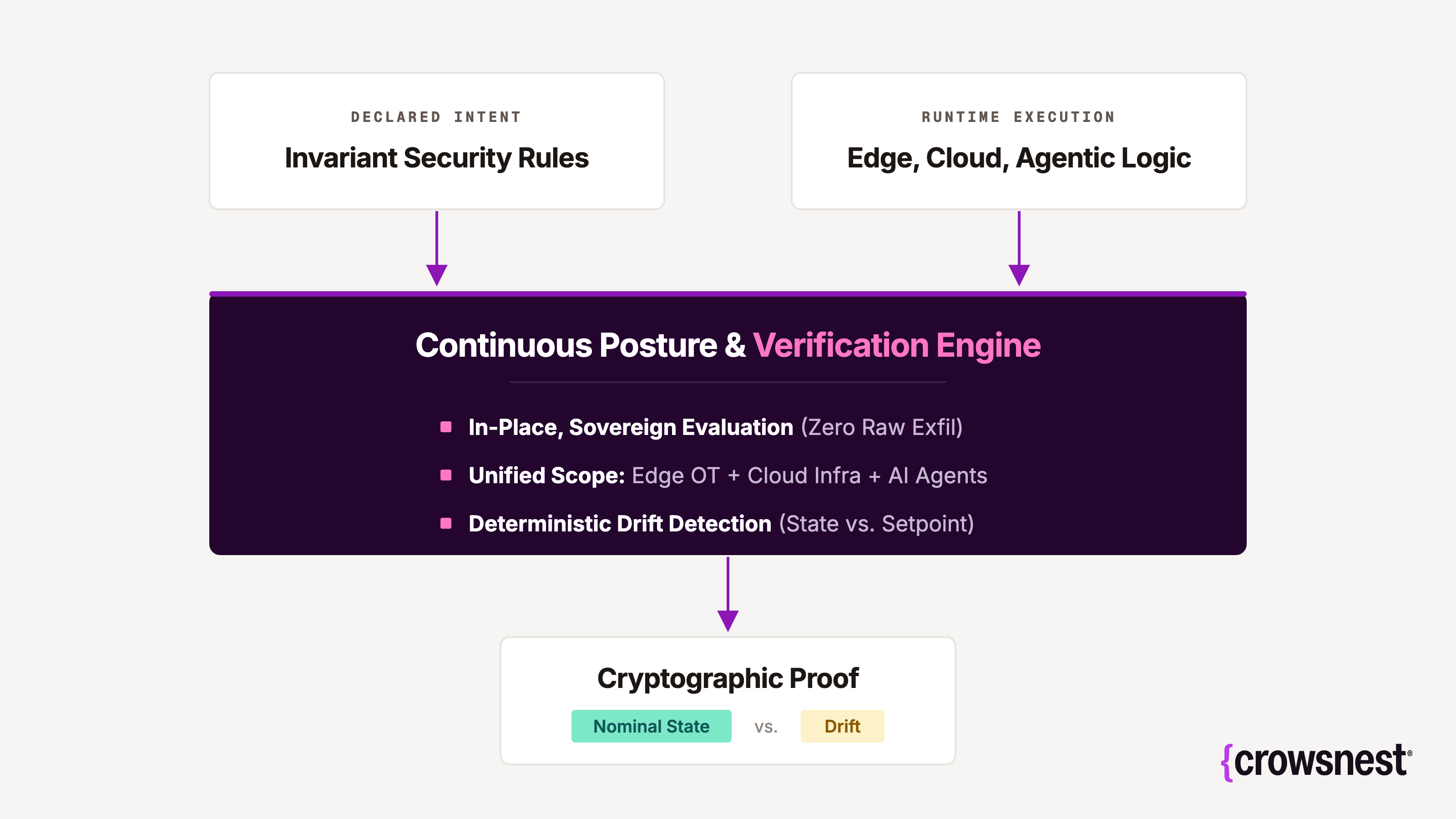
- In Place, Sovereign Execution: Validate configuration and runtime behavior where the system lives. Retain 100% data ownership. Export only cryptographic state proofs and drift alerts, never raw customer or operational payloads.
- Unified Scope (Edge, Cloud, and Agentic Code): Treat edge PLCs, infrastructure-as-code files, API access paths, and autonomous AI agents as a unified execution graph. If a component can affect state, it must be subject to continuous posture verification.
- Deterministic Behavioral Checks: Move beyond asking "Does this vendor claim to follow our policy?" Run deterministic tests: Can an unauthorized identity reach this controller interface? Does this firmware match an approved hash? Is this setpoint within safe operational bounds?
- Immediate Drift Attribution: When a system drifts, attribution must be instantaneous: determine whether the change originated from a scheduled engineering job, an autonomous optimization agent, or an unauthorized lateral connection.
What Engineering Leaders Should Audit This Week
If you oversee connected operational technology, edge systems, or hybrid cloud environments, begin with these technical baselines:
- Map All Setpoint-Modification Paths: Identify every logical path capable of altering physical or operational thresholds. Treat third party vendor access paths as high privilege execution vectors rather than passive monitoring feeds.
- Isolate Unpatchable Legacy Assets: End-of-life firmware that no longer receives security updates (like the Danfoss AK-SM 800 series) cannot be trusted on reachable networks. Place legacy controllers behind zero trust isolation proxies.
- Convert Policies into Machine-Verifiable Invariants: Translate human readable policy assertions into programmatic constraints evaluated continuously. Replace "vendor connections are secured" with an automated check that continuously flags any inbound session lacking verified mutual authentication.
- Audit for Deviation, Not Just Signatures: An unexpected setpoint shift is an immediate indicator of failure or compromise, regardless of whether signature based IDS/IPS tools trigger an alert.
Closing the Gap Between Intent and Reality
The supermarket attack in France is a clear demonstration that operational systems do not fail because organizations lack policies. They fail because operational reality drifts away from administrative intent without anyone noticing until physical damage occurs.
As systems become increasingly autonomous, distributed, and tied to physical outcomes, checking compliance on paper or via quarterly audits is no longer viable.
At Crowsnest, we build continuous posture automation that turns security requirements into verifiable, in-place checks across edge hardware, dynamic cloud infrastructure, and autonomous code delivering provable security while preserving absolute data ownership.
Sources & References
- CNN: French Supermarket Refrigeration Cyberattack (Reporting on retail compromises and physical temperature impacts)
- France 24: Retailers Confirm Supermarket Cyberattack (Store disruption details across French chains)
- CERT-FR / ANSSI: Alert on Danfoss Refrigeration Controllers AK-SM and AK-SC Series (Mitigation and isolation guidance)
- Cybernews: Denmark CPR Data Breach via Weak Password (Third-party supplier compromise exposing 8.8M records)